Patient Safety
From Incident Reporting to Meaningful Improvement: Turning Healthcare Events into Lasting System Change
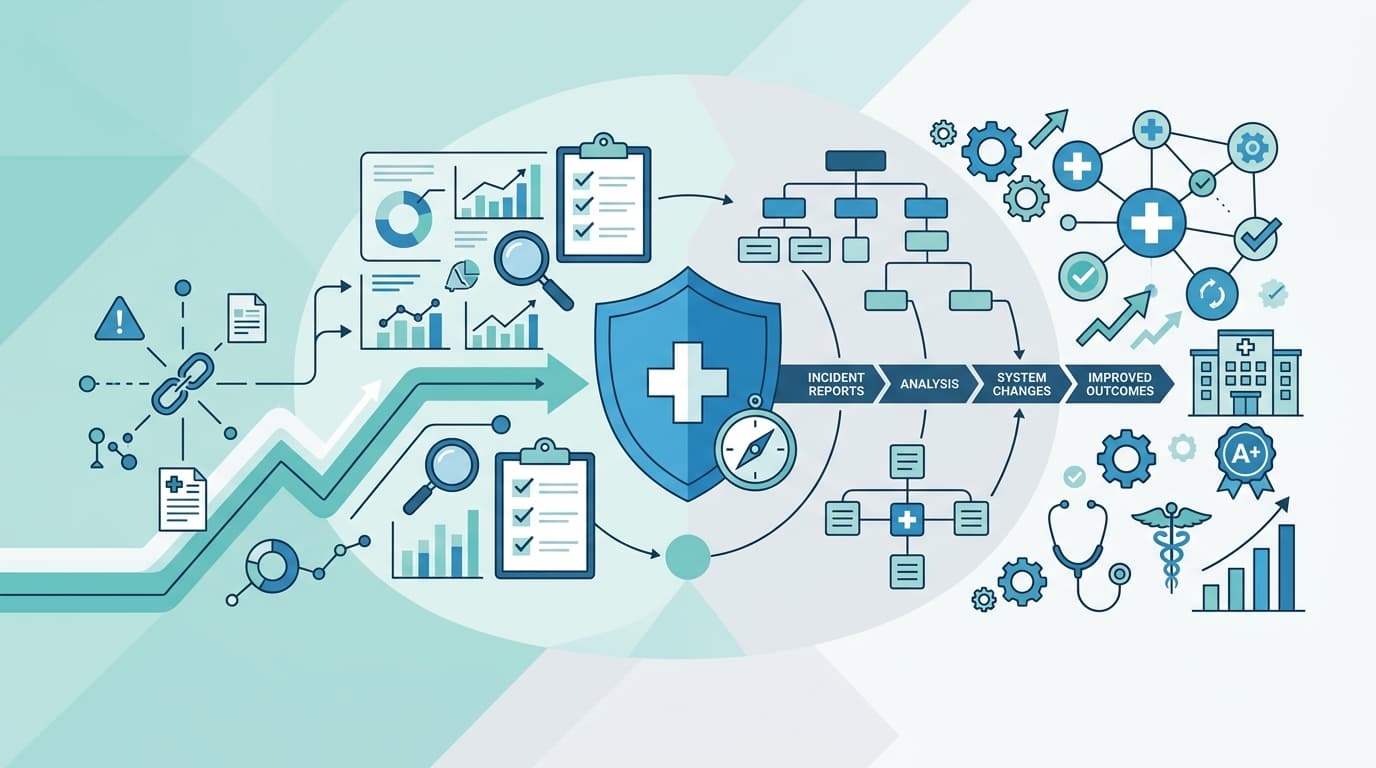
Table of Contents
- What Is a Patient-Safety Incident?
- Why Incidents Are Underreported
- Good Incident Analysis Begins with Good Documentation
- Immediate Response Must Come Before Investigation
- Incident Review Is Not the Same as Root-Cause Analysis
- Root-Cause Analysis: Looking Beneath the Visible Error
- Questions That Strengthen Root-Cause Analysis
- Useful Tools for Incident Analysis
- Corrective Action Must Address the Cause
- From Recommendations to a Measurable Action Plan
- Implementation Is Where Improvement Often Fails
- Verification, Validation and Effectiveness
- Sustaining Improvement
- Learning Should Extend Beyond One Incident
- Leadership Determines Whether Reporting Creates Change
- The Role of the Quality Team
- How to Know Whether the Safety Culture Is Improving
- A Practical Incident-Improvement Cycle
- Conclusion: Reporting Is Only the Beginning
- Frequently Asked Questions
Incident reporting is one of the most important foundations of patient safety. Yet the true value of an incident report does not lie in the number of forms completed or events entered into a register. Its value lies in what the healthcare organisation learns from the event—and what it changes as a result.
Many hospitals have incident-reporting systems, but not every reported incident leads to improvement. Reports may be collected, reviewed briefly and closed after counselling the staff member involved. Sometimes a new circular is issued or another training session is conducted. However, if the underlying weakness in the system remains unchanged, the same incident—or a slightly different version of it—is likely to recur.
The real objective of incident management is therefore not simply to document what went wrong. It is to understand why the event was possible, correct the contributing system weaknesses, verify that corrective actions are being followed and evaluate whether patient-safety outcomes have genuinely improved.
"A mature incident-management system converts individual events into organisational learning."
What Is a Patient-Safety Incident?
A patient-safety incident is any event or circumstance that resulted in—or could have resulted in—unnecessary harm to a patient.
Incidents may include:
- Medication errors
- Patient falls
- Wrong-patient, wrong-site or wrong-procedure events
- Delayed diagnosis or treatment
- Failure to recognise clinical deterioration
- Transfusion-related errors
- Healthcare-associated infections
- Equipment malfunction
- Communication and handover failures
- Specimen identification errors
- Surgical or procedural complications
- Failure to follow established safety protocols
- Breaches of confidentiality
- Occupational exposure affecting healthcare workers
Hospitals must also encourage the reporting of near misses. A near miss is an unsafe event that was detected before it reached the patient or caused harm.
Case Example: Near Miss
If a nurse notices that the wrong medicine has been dispensed before administering it, no patient injury has occurred. Nevertheless, the event is extremely valuable because it reveals a weakness in prescribing, dispensing, storage, labelling, verification or communication.
Waiting for harm before investigating a weakness is a dangerous approach. Near misses offer hospitals an opportunity to correct the system before a patient is injured.
Why Incidents Are Underreported
Underreporting remains one of the greatest challenges in healthcare safety systems. Staff may hesitate to report because they fear:
- Punishment or disciplinary action
- Damage to their professional reputation
- Criticism from seniors or colleagues
- Being labelled careless or incompetent
- Legal consequences
- Repeated questioning without constructive action
- A complicated and time-consuming reporting process
- Lack of confidentiality
- The belief that reporting will not lead to any change
An organisation cannot learn about risks that remain hidden. Leadership must therefore create psychological safety—a working environment in which staff can speak openly about mistakes, hazards and near misses without fear of unfair punishment.
This does not mean that every action is accepted without accountability. A fair safety culture differentiates between:
- Unintentional human error
- Risk-taking that has gradually become normalised
- System-induced mistakes
- Deliberate violation of essential safety requirements
- Reckless or knowingly unsafe behaviour
Human error should lead primarily to support and system improvement. Repeated risky behaviour may require coaching and stronger supervision. Deliberate or reckless conduct may require disciplinary action. Treating all these situations in the same way is neither fair nor safe.
A culture of blame drives incidents underground. A culture without accountability can also create harm. Hospitals need a balanced just culture that promotes both learning and professional responsibility.
Good Incident Analysis Begins with Good Documentation
An incident cannot be analysed effectively when the initial report is incomplete, emotional or based on assumptions. Incident documentation should capture facts clearly and objectively, including:
- What happened
- When and where it happened
- Who was involved
- What task or clinical process was being performed
- The patient’s condition before and after the event
- Immediate actions taken to protect the patient
- Relevant medicines, equipment, records or samples involved
- Witnesses or staff who may provide additional information
- Whether the patient and family were informed, where applicable
- Whether the treating clinician and appropriate leaders were notified
- Any immediate risk to other patients
The report should describe observable facts rather than assign blame.
The second description gives the analysis team useful, objective information about medicine storage, packaging similarity, verification practices and detection mechanisms.
Immediate Response Must Come Before Investigation
When an incident occurs, the first priority is always patient care—not completing the incident form. The immediate response should include:
- Assessing and stabilising the patient.
- Preventing further harm.
- Informing the treating clinician and relevant department leaders.
- Preserving medicines, equipment, records or other evidence required for review.
- Communicating with the patient and family appropriately and transparently.
- Reporting the event through the approved hospital system.
- Escalating serious events promptly to senior leadership.
- Considering whether other patients are exposed to the same immediate risk.
For example, if an incorrectly labelled medicine has been administered, the hospital should not restrict its response to the affected patient. It should immediately examine whether the same batch, storage location or labelling problem could affect other patients. This early containment is essential while the detailed investigation is undertaken.
Incident Review Is Not the Same as Root-Cause Analysis
Not every incident requires a full root-cause analysis. Events should be graded according to the severity of harm, likelihood of recurrence, detectability and potential consequences.
A minor incident may require a focused departmental review. A serious event, sentinel event, repeated event or high-risk near miss may require a formal multidisciplinary root-cause analysis.
However, the depth of analysis should not depend only on the degree of harm that happened on that particular occasion. A near miss with the potential to cause death or major harm deserves serious investigation even when the patient was unharmed.
The question should not be merely, "How much harm occurred?" It should also be, "What could reasonably have happened if the event had not been detected?"
Root-Cause Analysis: Looking Beneath the Visible Error
Root-cause analysis (RCA) is a structured method used to identify the underlying system factors that contributed to an incident. The purpose is not to find a single person to blame. It is to understand how multiple conditions aligned to make the event possible.
The visible error is often only the top of the problem. If a nurse administered the wrong medication, stopping the investigation at “the nurse did not check properly” is similar to trimming the visible leaves of a weed while leaving its roots untouched.
A deeper review may identify that:
- Look-alike medicines were stored together.
- The pharmacy label was unclear.
- The prescription contained an ambiguous abbreviation.
- The barcode system was unavailable.
- Staffing was inadequate during a busy shift.
- Interruptions were common during medicine administration.
- The patient identification process was inconsistent.
- The independent double-check was not clearly defined.
- Training had not been reinforced after introducing a new medicine.
- Similar near misses had occurred but were never analysed together.
The final unsafe act may have been committed by one individual, but the conditions enabling it were often created by several weaknesses in the system.
Questions That Strengthen Root-Cause Analysis
A meaningful analysis should ask:
- What was expected to happen?
- What actually happened?
- At what point did the process deviate?
- What barriers were supposed to prevent the event?
- Were those barriers absent, inadequate, bypassed or ineffective?
- Were policies and procedures practical and accessible?
- Did staff have the required knowledge, competence and supervision?
- Were workload, staffing or fatigue contributory factors?
- Did the physical environment contribute?
- Were communication and handover processes reliable?
- Did technology or equipment contribute?
- Had similar incidents or near misses occurred previously?
- Were previous corrective actions implemented and sustained?
- How was the event finally detected?
- Could the same weakness affect other departments or patients?
These questions move the investigation beyond the individual and towards the system.
Useful Tools for Incident Analysis
Hospitals may use different tools depending on the complexity of the event.
The Five Whys
The Five Whys technique involves repeatedly asking why an event occurred until the underlying contributing factors become clearer.
→ Because a similar-looking ampoule was selected.
→ Because both medicines were stored next to each other.
→ Because the storage system did not separate look-alike medicines.
→ Because the pharmacy had not completed a formal look-alike and sound-alike risk assessment.
→ Because responsibility, frequency and monitoring requirements had not been assigned.
This analysis reveals that asking one staff member to “be more careful” will not correct the storage and governance weaknesses.
Fishbone Analysis
A fishbone or cause-and-effect diagram helps teams examine contributing factors under categories such as:
- People
- Policies and processes
- Equipment and technology
- Environment
- Communication
- Training and competence
- Staffing and workload
- Leadership and supervision
- Patient-related factors
This helps prevent the investigation from becoming narrowly focused on a single person or activity.
Process Mapping
Mapping the complete process can reveal where the actual workflow differs from the approved procedure. It can identify duplication, unclear responsibilities, communication gaps, unnecessary steps and missing safety barriers.
Barrier Analysis
Barrier analysis examines which controls should have prevented the incident and why they failed. Barriers may include:
- Patient identification
- Alerts
- Checklists
- Independent double-checks
- Restricted access
- Standardised labels
- Electronic warnings
- Physical segregation
- Equipment alarms
- Supervision
- Competency assessment
The analysis should establish whether the barrier was missing, poorly designed, inconsistently followed or incapable of preventing the event.
Corrective Action Must Address the Cause
One of the most common weaknesses in incident management is the use of generic corrective actions. Typical responses include:
- Staff counselled
- Staff instructed to be careful
- Circular issued
- Training conducted
- Policy redistributed
- Warning letter given
These actions may sometimes be necessary, but they are rarely sufficient when used alone. Education depends heavily on memory and individual vigilance. Stronger interventions redesign the system so that the unsafe action becomes more difficult and the safe action becomes easier.
Depending on the incident, stronger corrective actions may include:
- Eliminating an unnecessary high-risk step
- Standardising the process
- Simplifying the workflow
- Separating look-alike medicines
- Introducing forcing functions or hard stops
- Improving equipment design or maintenance
- Standardising labels and colour coding
- Reducing interruptions during critical tasks
- Strengthening handover and escalation pathways
- Clarifying responsibility and accountability
- Introducing checklists at high-risk points
- Improving staffing or supervision
- Automating alerts and verification
- Conducting competency-based assessment
- Applying the solution across all relevant departments
Corrective actions should be practical, specific and proportional to the risk.
From Recommendations to a Measurable Action Plan
A recommendation such as “Improve medication safety” is too broad to guide implementation. Every corrective and preventive action should clearly state:
- The action to be completed
- The person responsible
- The departments affected
- The resources required
- The completion deadline
- The evidence required to confirm completion
- The process indicator to be monitored
- The expected outcome
- The date and method of effectiveness review
Example of a Strong Action Plan
“The Pharmacy Head will complete a hospital-wide risk assessment of look-alike and sound-alike medicines by 15 August. High-risk pairs will be physically separated, warning labels applied and the updated list communicated to all clinical units. Pharmacy and nursing supervisors will audit compliance weekly for four weeks and monthly thereafter. Repeat medication-selection errors and near misses will be reviewed for three months.”
This is far stronger and more actionable than documenting “Staff instructed to be careful.”
Implementation Is Where Improvement Often Fails
Many investigations produce reasonable recommendations but fail during implementation. The reasons may include:
- No clearly assigned owner
- Unrealistic deadlines
- Lack of financial or administrative support
- Corrective action confined to one department
- No communication with frontline staff
- Staff not trained in the revised process
- Policies updated without changing actual practice
- Lack of follow-up audits
- Leadership assuming that issuing an instruction equals implementation
A signed attendance sheet proves that training occurred. It does not prove that behaviour changed. Similarly, a revised policy proves that a document was updated. It does not prove that the new process is being practised at the bedside.
Implementation must therefore be verified where the work actually happens—during medication administration, handover, surgery, transfusion, sample collection, patient identification and other clinical activities.
Verification, Validation and Effectiveness
These terms are related but represent different levels of assurance.
1. Verification
Verification asks: Was the planned action completed?
Examples include: Was the policy revised? Was equipment repaired? Were medicines segregated? Was training completed? Was responsibility assigned?
2. Validation in Practice
Validation asks: Is the revised process workable and being followed correctly?
This may require direct observation, staff interviews, tracer methodology, record review, competency assessment, and departmental audits.
3. Effectiveness Evaluation
Effectiveness asks: Did the action reduce the risk or improve the outcome?
This involves monitoring: recurrence of the same incident, similar near misses, compliance with the revised process, adverse-event rates, response times, patient outcomes, staff feedback, audit results, and balancing measures.
Closing an incident immediately after corrective action is assigned is premature. Closure should occur only after implementation and effectiveness have been demonstrated.
Sustaining Improvement
An improvement is not successful simply because compliance was high during the first week. Hospitals should monitor whether the change is sustained over time through:
- Focused audits
- Safety rounds
- Tracer activities
- Departmental quality indicators
- Repeat observations
- Staff feedback
- Review of recurring incidents and near misses
- Periodic management evaluation
- Reassessment after staff turnover or workflow changes
A corrective action may initially appear successful but become ineffective because new staff were not trained, equipment changed, workload increased or supervision declined. Sustainability therefore requires periodic review—not permanent assumption.
Learning Should Extend Beyond One Incident
Hospitals often investigate incidents individually and miss broader patterns. Ten apparently minor medication incidents across different departments may indicate a common organisational weakness. Repeated delays in escalation may reveal problems in staffing, communication, clinical competence or hierarchy. Multiple patient falls may indicate environmental hazards, inadequate reassessment or failure to communicate fall risk during handover.
Incident data should therefore be analysed for:
- Frequency and severity
- Location and timing
- Type of harm
- Contributing factors
- Repeated processes
- Recurring departments
- High-risk patient groups
- Trends and historical effectiveness
Regular aggregation helps leadership move from reactive case management to proactive risk reduction. Learning must also be shared across the organisation. If a serious labelling error occurs in one ICU, the corrective action should not remain limited to that unit if the same risk exists elsewhere.
Leadership Determines Whether Reporting Creates Change
Leadership is the bridge between incident reporting and meaningful improvement. Senior leaders must ensure that:
- Staff can report incidents without fear of unfair punishment (psychological safety).
- Serious events are escalated promptly.
- Investigations are timely, structured and multidisciplinary.
- Patients receive immediate clinical care and appropriate communication.
- Investigations focus on systems as well as individual accountability.
- Corrective actions are adequately resourced.
- Responsibilities and deadlines are clearly assigned.
- Implementation is verified and outcomes are reviewed.
- Lessons are shared across departments and discussed at management and governance levels.
Leaders must also examine their own decisions. Staffing models, procurement choices, infrastructure limitations, unrealistic workloads and delayed maintenance can all contribute to unsafe conditions.
It is easy to ask, “Why did the staff member make this mistake?” Mature leadership also asks, “What conditions did our organisation create that made this mistake possible?”
The Role of the Quality Team
The quality department should facilitate the incident-management process, but it cannot own patient safety alone. The quality team may:
- Maintain the reporting framework and guide incident grading.
- Coordinate investigations and support root-cause analysis.
- Track corrective and preventive actions.
- Conduct audits and tracers, and analyse incident trends.
- Present findings to relevant committees and escalate overdue actions.
- Verify effectiveness and promote organisational learning.
However, corrective action must be owned by the department and leaders who control the process. Patient safety cannot become a file maintained only by the quality department. Clinical leaders, nurses, pharmacists, technicians, biomedical engineers, infection-control professionals, administrators and senior management must all participate.
How to Know Whether the Safety Culture Is Improving
An increase in incident reports does not automatically mean that the hospital has become less safe. It may indicate that staff trust the reporting system more and are increasingly willing to report near misses. A mature organisation should therefore avoid using low incident numbers as the sole measure of safety.
More meaningful indicators of a healthy safety culture include:
- Increase in near-miss reporting.
- Reduction in serious preventable harm.
- Timely completion of investigations.
- Quality of root-cause analyses.
- Percentage of corrective actions completed on time.
- Percentage of actions verified for effectiveness.
- Reduction in recurrence of similar incidents.
- Staff perception of psychological safety.
- Evidence of learning shared across departments.
- Leadership participation in safety reviews.
A Practical Incident-Improvement Cycle
A reliable, continuous incident-management system follows a complete loop:
- Report: Report the incident or near miss promptly.
- Respond: Respond immediately to protect the patient and contain the risk.
- Review: Review the facts objectively.
- Grade: Grade the event according to actual and potential harm.
- Analyse: Analyse the contributing factors and root causes.
- Recommend: Recommend strong, practical corrective and preventive actions.
- Assign: Assign responsibility, resources and deadlines.
- Implement: Implement the agreed changes.
- Verify: Verify that every action has been completed.
- Validate: Validate that the revised process is being followed in practice.
- Evaluate: Evaluate whether the risk and recurrence have reduced.
- Share: Share the learning throughout the organisation.
- Sustain: Sustain the improvement through continued monitoring.
If any of these stages is missing, the incident may be documented—but the organisation may not have truly learned from it.
Conclusion: Reporting Is Only the Beginning
An incident report is not the end of the process. It is the beginning of an opportunity to make care safer. The strength of a hospital’s safety culture is not measured by its ability to prove that incidents never occur. It is measured by how honestly the organisation identifies risks, how deeply it investigates them, how fairly it treats the people involved and how effectively it converts learning into safer systems.
Real improvement occurs when hospitals move beyond asking: “Who made the mistake?” and begin asking: “Why was this mistake possible, what barriers failed, and what must we change to prevent it from happening again?”
Incident reporting creates information.
Incident analysis creates understanding.
Implementation creates change.
Leadership makes that change last.
Frequently Asked Questions (FAQs)
1. What is the difference between a patient safety incident and a near miss?
A patient safety incident is any event that resulted in (or could have resulted in) unnecessary harm. A near miss is a specific type of incident where an unsafe event was detected and corrected before it actually reached the patient or caused harm.
2. What is a "just culture" in healthcare?
A just culture is a balanced approach to patient safety that differentiates between unintentional human error (which should be supported with system changes) and reckless or deliberate violations of safety protocols (which require accountability). It encourages open reporting without fear of blame, while maintaining professional responsibility.
3. Why is calling a staff member "careless" in documentation discouraged?
Saying someone was careless is a subjective conclusion and assigns individual blame rather than describing the objective facts. Useful documentation describes observable details (such as similar-looking packaging, proximity of medicines, and exact sequence of events) to help identify the underlying system weaknesses.
4. What tools are best for Root-Cause Analysis (RCA)?
Hospitals commonly use the Five Whys (asking "why" repeatedly to reach the underlying cause), Fishbone Analysis (categorizing contributing factors like people, process, equipment, environment), Process Mapping (analyzing workflow steps), and Barrier Analysis (checking which controls failed).
Ready to Assess Your Hospital's Readiness?
A Gap Audit is the first step towards successful accreditation. Understand your strengths, weaknesses, and get a clear action plan.
Learn About Our Gap Audit Service